lfp-v1x-exploratory-81eb2e2-5ae4d777-47646604
completed —
Hypothesis
A rectified-flow prior fitted to the aggregate posterior of the frozen canvas latent (vt-v1, c = 8) replaces its N(0, I) prior, whose draws decode to fragments, and so generates whole, novel OpenMoji-like drawings and interpolates through plausible drawings. The prior is a 9.7M-parameter DiT over standardised (8, 18, 18) grids (x_t = (1 - t) x_0 + t eps, velocity target, logit-normal t, EMA 0.999), trained on posterior draws of 32 exact variants per training icon (no compositions) and selected by EMA flow loss on the validation icons' latents. Samples: 50 Euler steps from noise scale 1 to z_hat_0, greedy IEEE float32 decoding by the VT. Scored afterwards by latent_metrics through the gallery backend canvas-flow on its fixed sets (339 samples, seed 23; 32 validation pairs x 9 frames, rng 17; CLIP ViT-B/32 at 72 px against the 339 validation renders; bootstrap intervals, paired where paired; copy rule without-twins): B1-B3 on the report with default settings (its samples block); B4 and B5 on the report run with --interpolation backend, whose interpolation block is canvas-flow's own path, the slerp below (the report records interpolation.path slerp-through-prior-noise). The default report's interpolation block is the frozen VT's lerp of posterior means and scores neither B4 nor B5. Pass requires B1-B3; B4 and B5 are the interpolation claims. (B1) fragment rate at most 10%. (B2) CLIP k-NN precision at least 2x the best latent-v2 prior row (N(0, I) or refit), and recall above it, both with intervals excluding zero. (B3) copy rate at most 10% and all 339 samples distinct. (B4) slerp through the prior's noise space (reverse-ODE inversion of both posterior means, slerp, forward integration): interior fragment rate at most 15%, jump share below latent-v2's (paired over pairs, interval excluding zero), detour rate at most 20%. (B5) slerp interior precision above v9 on pixel crossfades of the same pairs, paired, interval excluding zero; a failure is recorded as "the latent adds nothing over crossfade plus transcriber". Decision: B1-B3 pass - the gallery's main latent model. B3 fails - add compositions to the prior's data, then an earlier-stopped prior. B1 or B2 fails while B3 passes - a larger prior. Only B5 fails - keep the model; its interpolation is a dissolve. Reported without a criterion: validation flow loss against the Gaussian velocity, vt-v1's N(0, I) samples on the same seeds, lerp strips, watch-it-draw strips, ms per sample.
Visual output

Written result
Hypothesis. A rectified-flow prior fitted to the aggregate posterior of the frozen canvas latent (vt-v1, c = 8) replaces its N(0, I) prior, whose draws decode to fragments, and so generates whole, novel OpenMoji-like drawings and interpolates through plausible drawings. The prior is a 9.7M-parameter DiT over standardised (8, 18, 18) grids (x_t = (1 - t) x_0 + t eps, velocity target, logit-normal t, EMA 0.999), trained on posterior draws of 32 exact variants per training icon (no compositions) and selected by EMA flow loss on the validation icons' latents. Samples: 50 Euler steps from noise scale 1 to z_hat_0, greedy IEEE float32 decoding by the VT. Scored afterwards by latent_metrics through the gallery backend canvas-flow on its fixed sets (339 samples, seed 23; 32 validation pairs x 9 frames, rng 17; CLIP ViT-B/32 at 72 px against the 339 validation renders; bootstrap intervals, paired where paired; copy rule without-twins): B1-B3 on the report with default settings (its samples block); B4 and B5 on the report run with --interpolation backend, whose interpolation block is canvas-flow's own path, the slerp below (the report records interpolation.path slerp-through-prior-noise). The default report's interpolation block is the frozen VT's lerp of posterior means and scores neither B4 nor B5. Pass requires B1-B3; B4 and B5 are the interpolation claims. (B1) fragment rate at most 10%. (B2) CLIP k-NN precision at least 2x the best latent-v2 prior row (N(0, I) or refit), and recall above it, both with intervals excluding zero. (B3) copy rate at most 10% and all 339 samples distinct. (B4) slerp through the prior's noise space (reverse-ODE inversion of both posterior means, slerp, forward integration): interior fragment rate at most 15%, jump share below latent-v2's (paired over pairs, interval excluding zero), detour rate at most 20%. (B5) slerp interior precision above v9 on pixel crossfades of the same pairs, paired, interval excluding zero; a failure is recorded as "the latent adds nothing over crossfade plus transcriber". Decision: B1-B3 pass - the gallery's main latent model. B3 fails - add compositions to the prior's data, then an earlier-stopped prior. B1 or B2 fails while B3 passes - a larger prior. Only B5 fails - keep the model; its interpolation is a dissolve. Reported without a criterion: validation flow loss against the Gaussian velocity, vt-v1's N(0, I) samples on the same seeds, lerp strips, watch-it-draw strips, ms per sample.
Criteria
B1-B5 are scored after this run by latent_metrics through the gallery backend canvas-flow (339 samples, 32 pairs, CLIP, copy rule without-twins): B1-B3 on its default report, B4 and B5 on its --interpolation backend report, whose interpolation block is the slerp through the prior's noise (the default report's is the frozen VT's lerp). The numbers below are this run's own checks, not the criteria.
| criterion | claim |
|---|---|
| B1 | fragment rate at most 10% |
| B2 | CLIP precision at least 2x the best latent-v2 prior row, and recall above it, both with intervals excluding zero |
| B3 | copy rate at most 10% under copy rule without-twins, and all samples distinct |
| B4 | slerp interior fragments at most 15%, jump share below latent-v2's (paired), detours at most 20% |
| B5 | slerp interior CLIP precision above v9 on crossfades, paired |
Result (IEEE float32 greedy decoding (TF32 off: matmul and cuDNN); pixel metrics at 72 px)
| measure | value |
|---|---|
| validation flow loss, EMA (served) | 1.2587 |
| validation flow loss, Gaussian velocity (zero parameters) | 1.7629 |
| selected step | 38000 |
| flow samples distinct / rendered | 64 / 64 of 64 |
| flow samples with ink < 0.10 | 0.141 |
| parent VT, same N(0, I) seeds, ink < 0.10 | 0.328 |
| validation icons with ink < 0.10 | 0.021 |
| slerp interior frames with ink < 0.10 | 0.089 |
| lerp interior frames with ink < 0.10 | 0.071 |
| slerp endpoint pixel error (inversion round trip) | 0.0923 [0.0678, 0.1188] |
| lerp endpoint pixel error (VT from mu) | 0.0875 [0.0627, 0.1159] |
Resources
| measure | value |
|---|---|
| device | NVIDIA GeForce RTX 4080 |
| flow parameters (trained) | 9,747,744 |
| served parameters (flow + frozen VT) | 18,779,986 |
| train seconds | 1179 |
| peak VRAM GiB | 3.4414305686950684 |
| flow + graph decode, ms per sample, batch 1 | 1048.4 |
| flow alone, ms per sample, batch 1 | 60.3 |
| batched, ms per sample | 143.0 |
| torch / CUDA | 2.14.0a0+4fdf77b940.nv26.08 / 13.4 |
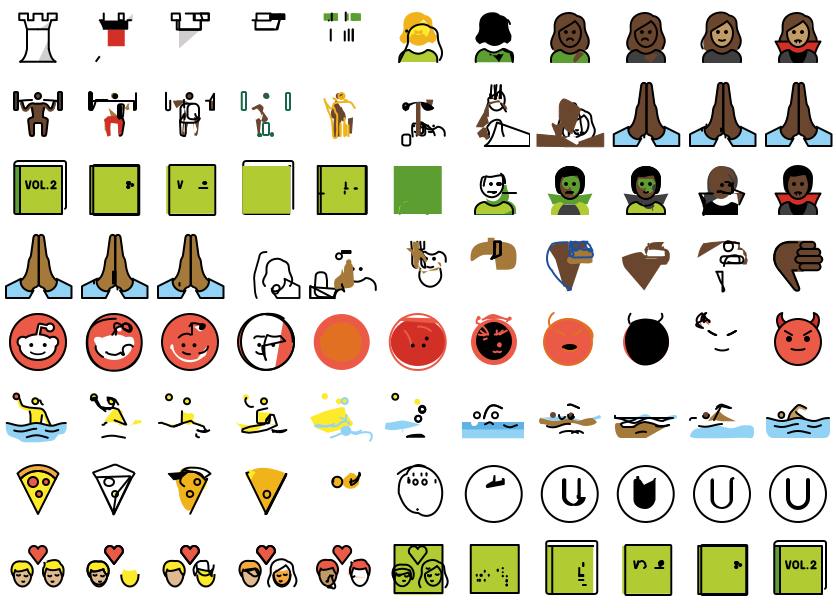
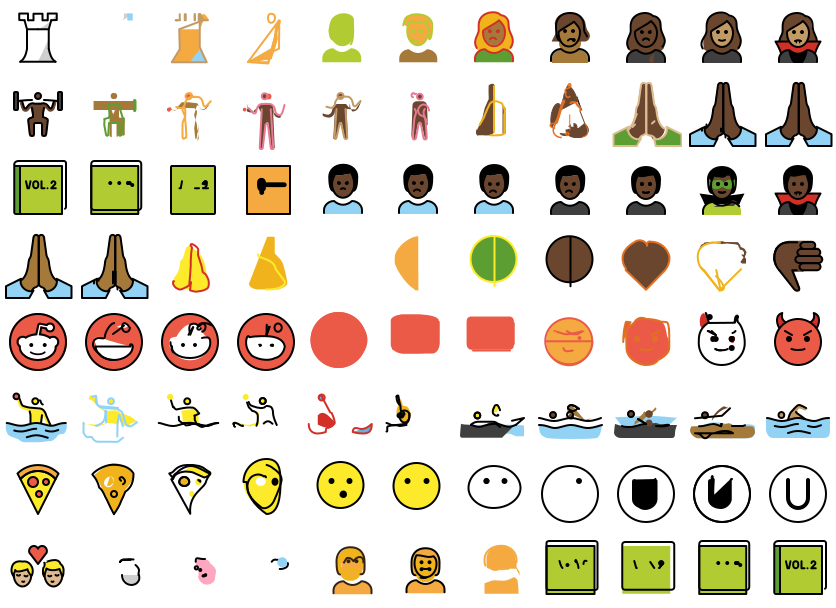
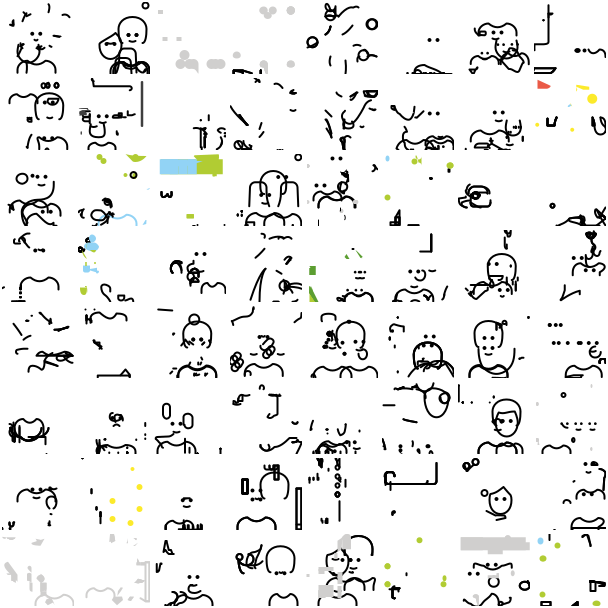
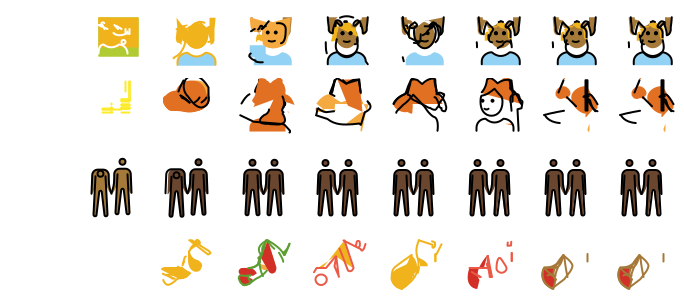
Sheets: prior-samples.png, vt-normal-samples.png (the parent's own prior on the same seeds), slerp-interpolations.png and lerp-interpolations.png (A, 9 frames, B), watch-it-draw.png (z_hat_0 at 8 flow times, then the sample).
State transitions
- running2026-09-29T15:27:09Z
- completed2026-09-29T15:48:01Z
Run record
Verbatim from runs/lfp-v1x-exploratory-81eb2e2-5ae4d777-47646604/run.yaml, the record committed before launch.
5ae4d777ae3f07b9…b43c20240ac47c38…2e9dfcbeb9a7882f…b43c20240ac47c38…476466042da98d72…476466042da98d72…