openmoji-g1-train-v2-renders-eff0038-9573bc74-9b9b1699
completed —
Hypothesis
A read-only probe, not a learning claim, so it carries no predeclared pass/fail criteria. The question is descriptive: at the v2 selected checkpoint's 0.2886 held-out aggregate and 0.0573 changed-token accuracy, what does the model's predicted clean state actually look like, and how much does it improve the render over the raw corrupted state it was given?
Why run it
Token accuracy is a poor proxy for whether a vector icon reads correctly, because a handful of wrong coordinates can destroy a shape that most-tokens-correct would call a success. Rendering the triple decides whether the Gate G scalars are overselling or underselling the visual result, and whether the corruption probability is even in a regime where the visual task is achievable.
Scope limits
Twelve held-out icons from the pilot's own 128-icon validation draw, one corruption draw each, at the single trained corruption probability of 0.35. Descriptive only. It trains nothing, changes no learning artifact, and is not a benchmark.
Measured result
Verbatim from the run's summary.json.
e791493769907ac4…9573bc740e90bf3a…c474c94db45be13f…703c68a6fbe33043…2e79da3ca8f92e3f…Visual output
Written result
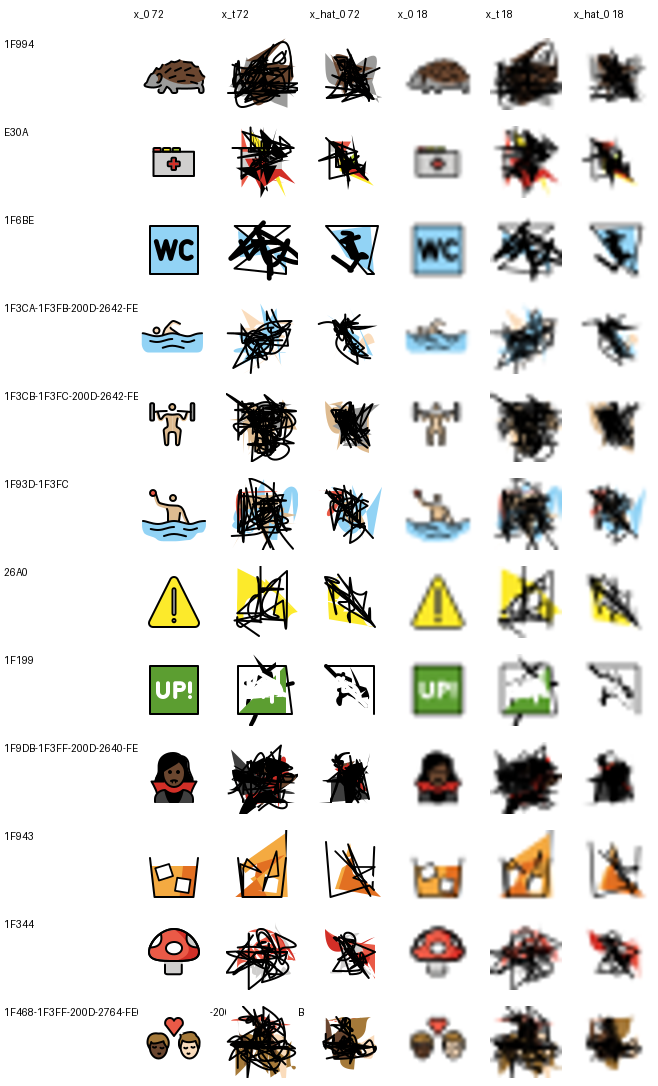
The v2 data-scale run reported 0.2886 held-out aggregate token accuracy and 0.0573 changed-token accuracy at its selected step. Neither number says whether the model's predicted clean state is a recognizable icon with some fields wrong or is rubble. This probe renders the triple for twelve held-out icons drawn from the pilot's own 128-icon validation set, using the pilot's own held-out corruption generator, so the pictures show exactly the inputs those scalars were computed on.
It is descriptive and carries no predeclared criteria. It trains nothing.
Result
| state and size | median RGBA MAE against x_0 |
|---|---|
x_t 72 px | 0.169546 |
x_hat_0 72 px | 0.142433 |
x_t 18 px | 0.182875 |
x_hat_0 18 px | 0.152770 |
The prediction reduces median RGBA error against the clean render by 16.0% at 72 px and 16.5% at 18 px relative to the corrupted input it was given. A second complete invocation reproduced every artifact hash.
!Held-out trajectory contact sheet

Reading the sheet
None of the twelve predictions is a recognizable icon. Both x_t and x_hat_0 read as scribble at both sizes.
What does survive is instructive. Fills, styles, and topology are not corrupted by this process - only geometry fields are - so large flat colour regions come through intact: the warning triangle 26A0 keeps its yellow field, the tumbler 1F943 its orange, the 1F199 badge its green. The stroke geometry is destroyed in every case. On a few icons the prediction is visibly less tangled than the corrupted input; on others the two are indistinguishable.
What this changes
Two things, and the second matters more.
First, the Gate G scalars oversell the visual result substantially. A 16% reduction in median render error is not a recovered icon, and 0.2886 aggregate token accuracy should not be read as one. Any future claim about Gate G recovery needs a render beside it.
Second, at corruption probability 0.35 the input x_t is already visually destroyed. The model is being trained and evaluated at a corruption level where the visual task may not be achievable at any model size, because a third of the geometry is simply gone. The project has held this probability fixed since the Gate F fixtures, where it was chosen for four-icon experiments, and has never varied it at corpus scale. That makes the corruption schedule a first-class candidate factor for the next experiment rather than a secondary one, and it argues for training across a range of corruption levels rather than at a single fixed point.
This is twelve icons at one corruption draw and one probability. It is a description of one checkpoint, not a benchmark.
State transitions
- completed2026-09-20T17:40:00Zscalars_oversell_the_visual_result_no_prediction_is_a_recognizable_icon
Run record
Verbatim from runs/openmoji-g1-train-v2-renders-eff0038-9573bc74-9b9b1699/run.yaml, the record committed before launch.
9573bc740e90bf3a…e791493769907ac4…9b9b1699677a6f97…703c68a6fbe33043…2e79da3ca8f92e3f…